
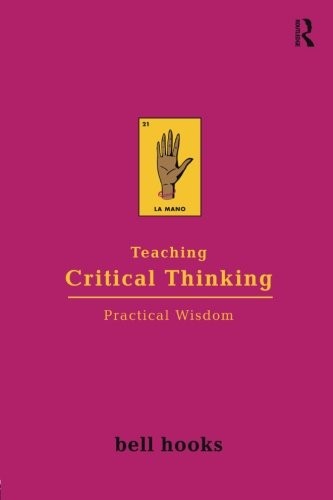
Teaching Critical Thinking: Practical Wisdom gathers bell hooks’ reflections on education, dialogue, authority, reading, imagination, and democratic participation. Its short teachings connect classroom practice with the larger work of learning how to question domination.
This page describes the Routledge paperback identified by ISBN 9780415968201: 208 pages, published September 18, 2009.
Affiliate disclosure: As an Amazon Associate, we may earn a commission from qualifying purchases made through this link, at no additional cost to you.
Overview
Teaching Critical Thinking: Practical Wisdom presents bell hooks’ educational ideas through compact reflections on teaching and learning. The book addresses dialogue, reading, imagination, authority, race, gender, class, and the habits that help students become active participants in knowledge.
Critical thinking is not simply argument or skepticism. It requires curiosity, careful listening, willingness to revise assumptions, and the courage to connect ideas with lived experience.
Major themes
Education as participation
Students learn more fully when they are treated as contributors rather than passive recipients. Teachers remain responsible for structure while making space for meaningful voice.
Dialogue and disagreement
A democratic classroom does not avoid conflict. It develops practices that allow disagreement to produce inquiry rather than humiliation or silence.
Practical wisdom
The short-form chapters keep theory close to decisions educators make about attention, authority, community, and care.
Book details
| Full title | Teaching Critical Thinking: Practical Wisdom |
|---|---|
| Author | bell hooks |
| Publisher | Routledge |
| Publication date | September 18, 2009 |
| Format | Paperback |
| Length | 208 pages |
| ISBN-10 | 0415968208 |
| ISBN-13 | 9780415968201 |
| Language | English |
Related reading
Teaching to Transgress establishes engaged pedagogy, while Teaching Community focuses on belonging and hope.
Who should read it?
The book suits teachers, students, facilitators, and readers seeking brief, discussion-ready reflections on liberatory education.