
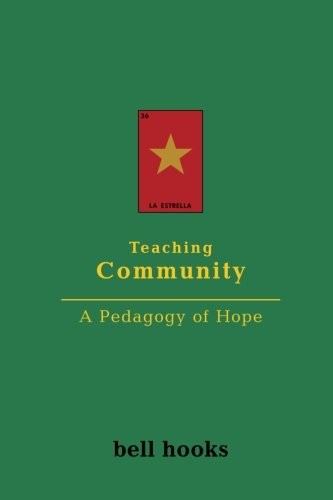
Teaching Community: A Pedagogy of Hope extends bell hooks’ vision of engaged education beyond the individual classroom. Through essays grounded in teaching experience, she considers how educators and students can confront racism, class hierarchy, fear, conflict, and exclusion while building communities committed to freedom.
This page describes the first-edition Routledge paperback identified by ISBN 9780415968188: 216 pages, published August 27, 2003.
Affiliate disclosure: As an Amazon Associate, we may earn a commission from qualifying purchases made through this link, at no additional cost to you.
Overview
Teaching Community: A Pedagogy of Hope asks how education can create belonging without denying conflict or difference. bell hooks expands the engaged pedagogy associated with her earlier teaching work, focusing on the relationships and shared responsibilities that make liberatory learning possible. The classroom remains important, but community is not confined to school walls. Learning occurs wherever people practice dialogue, accountability, and care.
The book combines reflection on teaching with discussion of race, class, gender, spirituality, intimacy, and democratic participation. hooks resists both nostalgia for an ideal classroom and cynicism about education’s limits. Hope, in this framework, is a discipline: people build it by facing domination directly while continuing to create conditions in which everyone can speak, learn, and change.
What the book argues
Education cannot be democratic if only a few people are treated as legitimate knowers. hooks argues that teachers bring histories, identities, and power into the classroom, just as students do. Acknowledging those realities does not weaken intellectual rigor. It makes possible a more honest account of how knowledge is produced and shared.
Community also requires more than friendliness. Genuine learning communities must be able to address racism, class privilege, fear, anger, and disagreement. hooks is interested in practices that keep conflict from becoming domination: listening, critical reflection, willingness to revise one’s position, and respect for the presence of every participant.
Major themes
Democratic education
hooks treats participation as essential to learning. The teacher has responsibilities and authority, but authority need not become authoritarian control. Students learn more fully when their voices matter and when expectations are transparent.
Race and the work of desegregation
Physical integration alone does not create equality. The book considers the emotional and institutional work required to confront white supremacy and build relationships across racial difference.
Class and belonging
Class shapes language, confidence, access, and assumptions about intelligence. hooks asks educators to recognize these pressures without reducing students to social categories.
Hope as practice
Hope is not a refusal to see injustice. It is the choice to keep building conditions for transformation even when institutions resist change.
Book details
| Full title | Teaching Community: A Pedagogy of Hope |
|---|---|
| Author | bell hooks |
| Publisher | Routledge |
| Edition | First edition |
| Publication date | August 27, 2003 |
| Format | Paperback |
| Length | 216 pages |
| ISBN-10 | 0415968186 |
| ISBN-13 | 9780415968188 |
| Language | English |
Edition note
The bibliographic details above identify the first-edition Routledge paperback with ISBN 9780415968188. Use that ISBN when comparing other formats or printings.
Related reading
Teaching to Transgress introduces many of the principles that this book extends. Teaching Critical Thinking offers shorter reflections on practical questions of learning, while Where We Stand deepens the discussion of class.
Who should read it?
The book is useful for teachers, students, facilitators, librarians, organizers, and anyone responsible for a learning community. It is not a classroom-management manual. Its value lies in the ethical and political questions it asks: who belongs, who speaks, how authority operates, and what practices allow people to remain in dialogue across difference.
Incredible. I added the quotes I noted for my reference here (the private notes section was too small).
This book was exactly what I needed to read while managing both the excitement and dread of going back to school—excitement for learning and dread of institutions. I loved Bell Hooks’ writing about maintaining a connection to self and spirituality in education, remaining grounded in our senses and experiences rather than denying our realities with false claims of objectivity and seeing education as a practice of freedom. Overall, this book left me feeling realistic yet hopeful.
It is a perplexing book—if you look at it as a collection of essays, it makes more sense, but taken together, it’s a bizarre reading experience. One of the reasons for this is that this is undoubtedly the single most poorly copy-edited book I have ever read. It’s hard to get through more than a few pages at a time without stumbling across a howler of a grammatical or sentence error that an editor has let stand. From time to time, these errors are sneaky, but mostly, they’re glaring and obvious, interrupting the flow of the text and/or confusing the reader. That they were left the way they are is a sign of breathtaking incompetence on the part of the publisher—and a little startling, considering that Routledge has a pretty good reputation as a reliable academic publisher.
Bell Hooks critically examines postmodern theory, emphasizing the importance of grounding discussions of “difference” in real-world struggles against oppression. Her insights are accessible and deeply impactful.
This collection pushes readers to rethink preconceived notions about race and gender. Hooks’s analysis is rigorous and thought-provoking, blending personal reflections with academic discourse.
In Teaching Community, hooks navigate complex topics with clarity and passion. Her essays on postmodernism and its relation to black experiences are particularly enlightening.
Hooks’s exploration of the intersections between race, gender, and culture provides invaluable perspectives for feminist discourse. Her work bridges theory and practice, making it a cornerstone of feminist studies.
Teaching Community is a testament to Bell Hooks’s ability to engage readers in critical conversations about society. Her reflections on cultural politics are both personal and universal.
Hooks’s writing style is engaging and accessible, making complex theories understandable to a broad audience. Her discussions on the politics of race and gender are especially noteworthy.
This book comprehensively examines the cultural politics surrounding race and gender. Hooks’s critical analysis is insightful and necessary for understanding societal issues.