
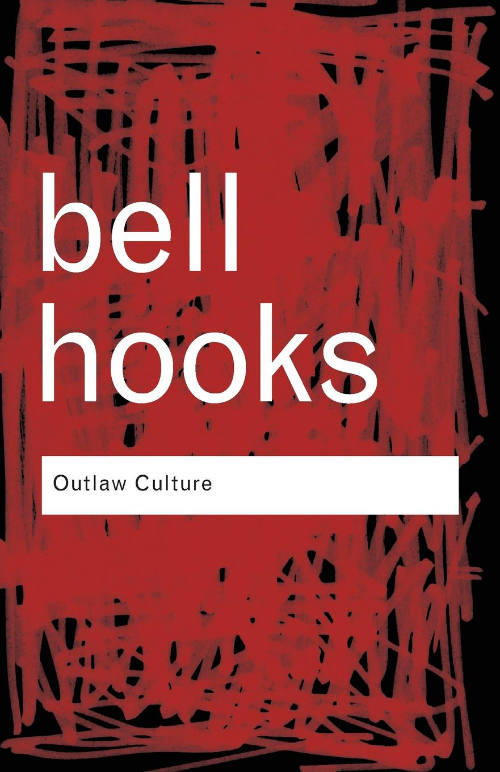
Outlaw Culture: Resisting Representations collects bell hooks’ cultural criticism on race, gender, class, sexuality, art, film, music, and celebrity. The essays ask how popular representation teaches audiences to accept domination—and how critical viewing can create resistance.
Affiliate disclosure: As an Amazon Associate, we may earn a commission from qualifying purchases made through this link, at no additional cost to you.
Overview
Outlaw Culture: Resisting Representations brings together bell hooks’ essays and conversations about popular culture. Film, visual art, music, celebrity, and mass media become sites where ideas about race, gender, class, and sexuality are produced and contested.
hooks rejects the assumption that entertainment is politically neutral. Images help teach audiences whom to desire, fear, admire, or dismiss. Yet viewers are not passive. Critical engagement can reveal the interests behind a representation and open space for different stories.
Major themes
Representation and power
The collection examines who controls images and whose experiences are made visible. Inclusion alone is not enough when new images repeat familiar hierarchies.
Popular culture as a classroom
Mass media circulates ideas about identity far beyond formal education. hooks treats criticism as a public practice that helps people recognize those lessons.
Resistance and pleasure
Critical viewing does not require abandoning pleasure. The essays model a way of enjoying cultural work while remaining attentive to its politics and contradictions.
Book details
| Full title | Outlaw Culture: Resisting Representations |
|---|---|
| Author | bell hooks |
| Form | Essays and cultural criticism |
| Edition record | The local catalog does not yet contain verified ISBN, publisher, date, format, or pagination fields for the linked edition. |
Related reading
Black Looks develops hooks’ analysis of racial representation. Reel to Real concentrates on film, while Art on My Mind focuses on visual art.
Who should read it?
The collection suits readers interested in media studies, cultural criticism, film, music, feminism, and the politics of representation. Its essay format also makes it useful for courses and discussion groups.
I didn’t expect this book to be nearly as clear or readable as it was. The more I think about it, the more it seems to be an indictment of general academic writing—particularly progressive writing that seeks to provide tools for the liberation of the oppressed. By making what is said utterly incomprehensible to those most in need of those words, we are doing them a double disservice. We deny them access even to the puny hope our ideas might offer them.
In her most recent volume of cultural criticism, Bell Hooks analyzes “outlaw” culture—forms of cultural expression associated with contemporary society’s margins—and the politics of cultural interpretation. Her essential theme is that while many academics assume that the culture of the margins is subversive, that it represents an authentic expression of the values and beliefs of marginalized groups, in fact, these works often serve conservative ends, reinforcing stereotypes and ultimately reaffirming conventional norms. A class analysis lies behind this conclusion: elites play a significant role in shaping popular culture’s images and consumption.
Bell Hooks, one of America’s leading black intellectuals, is also one of our most clear-eyed and penetrating analysts of culture. Outlaw Culture gives us hooks on many of the most important subjects of the contemporary scene, from date rape, censorship, and ideas of race and beauty, to gangsta rap, the dilemmas of feminism, and the rise of black intellectuals. Using the mix of essays and sometimes highly personal dialogues for which she is well known, hooks takes on Spike Lee and Naomi Wolf, Malcolm X and Madonna, Camille Paglia, Jean-Michel Basquiat, and Ice Cube, and the films The Bodyguard and The Crying Game. She speaks movingly about male violence against women, about black self-hatred, and about the ways an oppressive society creates its outlaws.
This was my first entire book by Bell Hooks. I’m mad I didn’t read more of her sooner. Her insights from 30 years ago are still relevant. I’m glad her voice gets louder each generation, and her ideas are becoming more mainstream and less “outlaw.” The only way you can tell this is a book from the 1990s is the culture she critiques, e.g., Madonna, The Bodyguard, etc.
I want to sit with bell hooks and ask her what she thinks.
I wonder why this collection of essays isn’t more well-known. Reading bell hooks before 1998-99 is such a treat. The language does sound more objective, and the arguments are more nuanced than in her later works, such as “All About Love” or “The Will to Change.” The collection suffers a bit from miscellaneousness: the two self-interviews at the end and the dialogue with Cornel West right before seem random but will become a staple in her later books of this format. The film critiques sound super fascinating, but without seeing the movies, I can’t tell how off or on point her critiques are; interesting, nevertheless. Like the essays on ethnography, Zora Neale Hurston and Malcolm X, it wouldn’t be super engaging if you haven’t read the works she discussed.
The rest is excellent! In the 3rd essay, Bell Hooks discusses postmodernism in academia at the time, its pitfalls and potential, and its importance for anti-racist movements. The 4th essay concerns history, memory, and black Americans’ struggle. It does touch a bit on postmodernism again, especially the postmodernists’ tendency to dismiss everyday black folks’ conceptions of “black soul” and “authenticity”… due to postmodernism’s rejection of essentialism. Though constructing an idea of “the black experience/essence/soul/…” can be dangerous in her view (for example, labeling people as “not black enough,” “Oreo,”… which Bell Hooks has seen firsthand as a professor), there’s a reason why this construction exists: the images people have about “authentic/real black life” are rooted in the history of Southern rural black folks – which should be regarded as a legacy and not as an essence, bell hooks said “We can value and cherish the “meaning” of this experience without essentializing it.” She finds the contemptuous dismissal of this phenomenon to be disturbing, saying, “Already coping with a sense of extreme fragmentation and alienation, black folks cannot afford the luxury of such dismissal.” She goes on to talk a bit more about history, which I find to be pertinent. The 5th essay (Homeplace: A Site of Resistance) is my favorite from this collection. Bell Hooks points out how the gigantic labor of black women in maintaining the home (social reproduction, in short, even though she didn’t once use this word or mention materialist feminists in this essay). She talks about the crucial role this labor plays in the struggle against oppression and how it has been entirely ignored by black men in the anti-racist movements. There are many other interesting essays, especially the 10th one where the TEA IS playing hot. Bell Hooks talks here about solidarity among feminists and recounts a horrible experience at a conference where a very prominent Third World feminist scholar, who’s older than Hooks and “whose work has received the most extensive legitimation in privileged white academic circles,” basically trashed her in “very fancy terms.” I couldn’t find any info about this. Still, something tells me she was talking about Spivak… But I guess we’ll never know, lol. But yes, read this collection, and if possible, watch the movies she critiqued first.