
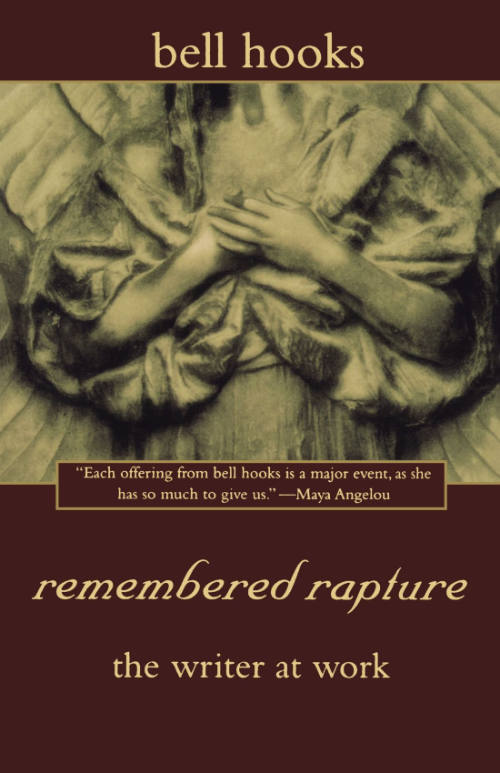
In this contemplative collection of essays, Bell Hooks addresses several issues, including racism, sexuality, art, history, and feminism, through her postmodernist perspective. She also celebrates various aspects of literacy, such as the joy of writing and reading, in the Remembered Rapture.
Hooks is always optimistic that she will eventually raise awareness of gender and race oppression to help empower women. Her work is often relatable because she artistically uses personal experiences to illustrate various concepts and ideas in writing. She has consistently proven that, regardless of her life challenges and career path, she is not afraid to face them. She is dedicated to writing about issues that most writers find a little too sensitive, especially women writers who find it challenging to create work that goes against the grain.
Hooks learned the power of the written word and the value of speaking her mind early on. She has lectured at Yale and Oberlin, among other colleges.
Overview
Remembered Rapture: The Writer at Work is bell hooks’ collection of essays on writing, reading, publishing, criticism, and the spiritual dimensions of creative practice. Part literary reflection and part professional critique, it examines what it means to build a writing life while navigating institutions that commodify identity and reward narrow expectations.
The title names the private intensity of creation: the moment when language takes shape and the writer becomes absorbed in the work. Hooks places that experience beside practical questions about audience, discipline, artistic integrity, and the politics of publication.
Major themes
Writing as vocation and practice
Writing is neither pure inspiration nor simply a career. It requires attention, solitude, risk, revision, and a willingness to follow the form a work demands.
Publishing and cultural expectation
Hooks scrutinizes the market pressures placed on Black writers, especially the demand to make identity legible in commercially approved ways.
Reading other writers
Her engagement with other authors demonstrates that a writer’s life is also a reader’s life. Criticism becomes a form of conversation about craft, freedom, and responsibility.
Book details
| Full title | Remembered Rapture: The Writer at Work |
|---|---|
| Author | bell hooks |
| Genre | Essays on writing and literary culture |
| Edition record | The local catalog does not identify a verified ISBN, publisher, publication date, format, or page count for the linked edition. |
| Language | English |
Why the collection matters
The book refuses a split between creativity and critique. Hooks writes about the pleasure of making art while remaining alert to the economic and institutional forces that determine which writers are published, promoted, or constrained.
Related reading
Wounds of Passion approaches the writing life through memoir, while Bone Black traces the childhood formation of hooks’ voice. Talking Back connects voice to feminist resistance.
Who should read it?
Writers, teachers, editors, literary critics, and readers interested in Black women’s intellectual and creative labor will find a sustained account of how art is made within—and sometimes against—the marketplace.
I am a white, cis-gender heterosexual male and an evangelical. Everything Bell Hooks writes is worth reading. This is a book on the process and craft of writing (and only a sort of cultural critique). Hooks opens up about her journey as a writer and the challenges of being a woman and a minority in a commoditized and white male hegemonic publishing industry.
This was a rocky journey, and let me tell you why: p. 13 “For the vast majority of my life I have longed to write” p. 14 “Once I began to write books regularly, sometimes publishing two at the same time, more and more comments were made to me about how much I was writing.” p. 15 “To overcome fears about writing, I began to write every day. My process was not to write a lot but to work in small increments, writing, and rewriting. Of course, I found early on that these small increments would ultimately become a book if I did this diligently.” p. 16 “I know this body of work emerged because I am repeatedly overwhelmed by ideas I want to put in writing. Since my interests are broad, I am not surprised that there is an endless flow of ideas in my mind.” p. 18 “My zeal for writing has intensified over the years, and the incredible affirming feedback from readers is one catalyst.”
Bell Hooks, one of America’s leading black intellectuals, is also one of our most clear-eyed and penetrating analysts of culture. Outlaw Culture gives us hooks on many of the most important subjects of the contemporary scene, from date rape, censorship, and ideas of race and beauty, to gangsta rap, the dilemmas of feminism, and the rise of black intellectuals. Using the mix of essays and sometimes highly personal dialogues for which she is well known, hooks takes on Spike Lee and Naomi Wolf, Malcolm X and Madonna, Camille Paglia, Jean-Michel Basquiat, and Ice Cube, and the films The Bodyguard and The Crying Game. She speaks movingly about male violence against women, about black self-hatred, and about the ways an oppressive society creates its outlaws.
This was my first entire book by Bell Hooks. I’m mad I didn’t read more of her sooner. Her insights 30 years ago are still relevant. I’m glad her voice gets louder with each generation, and her ideas are becoming more mainstream and less “outlaw.” The only way you can tell this is a book from the 90s is the culture she critiques, e.g., Madonna, The Bodyguard, etc.
I want to sit with bell hooks and ask her what she thinks.
I wonder why this collection of essays isn’t more well-known. Reading bell hooks before 1998-99 is such a treat. The language does sound more objective, and the arguments are more nuanced than in her later works, such as “All About Love” or “The Will to Change.” The collection suffers a bit from miscellaneousness: the two self-interviews at the end and the dialogue with Cornel West right before seem random but will become a staple in her later books of this format. The film critiques sound super fascinating, but without seeing the movies, I can’t tell how off or on point her critiques are; interesting, nevertheless. Like the essays on ethnography, Zora Neale Hurston and Malcolm X, it wouldn’t be super engaging if you haven’t read the works she discussed. The rest is excellent! In the 3rd essay, Bell Hooks discusses postmodernism in academia at the time, its pitfalls and potential, and its importance for anti-racist movements. The 4th essay concerns history, memory, and black Americans’ struggle. It does touch a bit on postmodernism again, especially the postmodernists’ tendency to dismiss everyday black folks’ conceptions of “black soul” and “authenticity”… due to postmodernism’s rejection of essentialism. Though constructing an idea of “the black experience/essence/soul/…” can be dangerous in her view (for example, labeling people as “not black enough,” “Oreo,”… which Bell Hooks has seen firsthand as a professor), there’s a reason why this construction exists: the images people have about “authentic/real black life” are rooted in the history of Southern rural black folks – which should be regarded as a legacy and not as an essence, bell hooks said “We can value and cherish the “meaning” of this experience without essentializing it.” She finds the contemptuous dismissal of this phenomenon to be disturbing, saying, “Already coping with a sense of extreme fragmentation and alienation, black folks cannot afford the luxury of such dismissal.” She goes on to talk a bit more about history, which I find to be pertinent.
The 5th essay (Homeplace: A Site of Resistance) is my favorite from this collection. Bell Hooks points out how the gigantic labor of black women in maintaining the home (social reproduction, in short, even though she didn’t once use this word or mention materialist feminists in this essay). She talks about the crucial role this labor plays in the struggle against oppression and how it has been entirely ignored by black men in the anti-racist movements. There are many other interesting essays, especially the 10th one where the TEA IS playing hot.
bell hooks writes with such intimacy and candor about the writing process. Her reflections on Black women’s challenges in the literary world are powerful and deeply resonant. This book is inspiring for anyone who dreams of writing.
This book explores the craft of writing and its emotional and political layers. Hooks’s insight into how race and gender shape a writer’s journey is invaluable. It is a must-read for aspiring authors.
Hooks beautifully captures the struggles and triumphs of being a writer. Her perspective as a Black woman adds depth to her insights, making this book both personal and universal. I highly recommend it for creatives of all backgrounds.
Reading Remembered Rapture felt like sitting down with a mentor who understands the complexities of writing. Hooks’s reflections on creativity and perseverance are a gift to anyone navigating the literary world.
This book isn’t just about writing—it’s about finding your voice in a world that often tries to silence it. hooks’s essays are empowering, especially for writers from marginalized communities—a treasure for any bookshelf.
hooks provides a nuanced look at the intersection of identity and creativity. Her honesty about her own experiences makes this book deeply relatable and inspiring. It’s one I’ll return to again and again.
Hooks’s remarkable ability to connect writing with broader social issues is evident. She shows how writing can be both a personal practice and a tool for cultural change. This book is a must-read for anyone who wants to write with purpose.
Hooks’s reflections on her writing journey are both raw and profound. Her ability to discuss the challenges of being a Black woman in the literary world while offering encouragement is what makes this book so impactful—truly inspiring.