
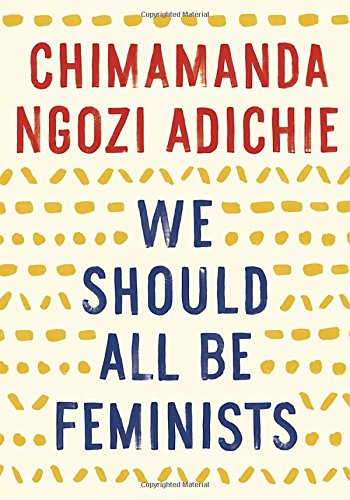
The highly acclaimed, provocative New York Times bestseller—a personal, eloquently-argued essay, adapted from the much-admired TEDx talk of the same name—from Chimamanda Ngozi Adichie, award-winning author of Americanah. Here she offers readers a unique definition of feminism for the twenty-first century, one rooted in inclusion and awareness. Drawing extensively on her own experiences and her deep understanding of the often masked realities of sexual politics, here is one remarkable author’s exploration of what it means to be a woman now—and an of-the-moment rallying cry for why we should all be feminists.
Related reading note: We Should All Be Feminists is written by Chimamanda Ngozi Adichie, not bell hooks. It is included here as a complementary work for readers exploring accessible introductions to feminist thought.
Overview
Adapted from Adichie’s TEDx talk, We Should All Be Feminists is a concise personal essay about gender expectations and the continuing need for feminism. Adichie uses experiences from Nigeria and the United States to show how inequality is learned through ordinary interactions, language, family roles, education, work, and public space.
The essay’s brevity is part of its function. It offers a clear invitation to readers who may see feminism as hostile, outdated, or irrelevant, then reframes it as a shared project of changing the limits placed on people because of gender.
Major themes
Gender is taught
Adichie emphasizes that social expectations are learned rather than inevitable. If people teach boys and girls different rules about ambition, emotion, money, or authority, those lessons become adult inequality.
Feminism and inclusion
The essay argues for naming sexism directly while inviting people of all genders into the work of change. Its approach is introductory and grounded in recognizable examples.
Personal narrative as argument
Stories make the essay accessible, but they also demonstrate how large systems operate through small moments. The personal examples give readers a way to test abstract claims against everyday life.
Book details
| Full title | We Should All Be Feminists |
|---|---|
| Author | Chimamanda Ngozi Adichie |
| Publisher | Anchor |
| Publication date | February 3, 2015 |
| Edition | Reprint |
| Format | Paperback |
| Length | 64 pages |
| ISBN-10 | 110191176X |
| ISBN-13 | 9781101911761 |
| Language | English |
How it compares with bell hooks
Adichie’s essay and bell hooks’ Feminism Is for Everybody share a commitment to making feminism understandable beyond academic settings. Hooks offers a broader movement-centered introduction, emphasizing interlocking systems of race, class, and gender and defining feminism as a struggle to end sexism and sexist oppression. Reading the works together reveals two distinct voices addressing different audiences and contexts.
Related bell hooks reading
Start with Feminism Is for Everybody for hooks’ accessible overview. Continue with Feminist Theory for a deeper account of feminism from the margins and Ain’t I a Woman for historical analysis of racism and sexism.
Who should read it?
This essay is well suited to first-time readers of feminist nonfiction, book groups, classrooms, and anyone seeking a short text that can begin a larger conversation.